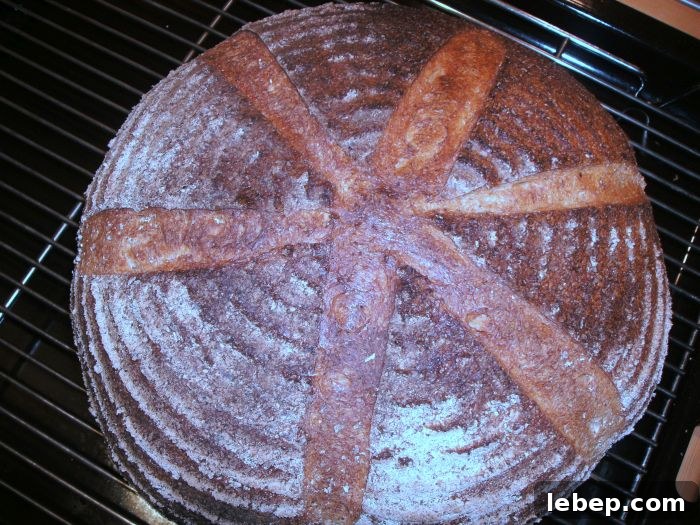
In January I published a guide on making sourdough bread and was surprised by the response. Many readers wrote to say they had started baking sourdough because of that post. I’ve since joined the Real Bread Campaign and recommend checking their resources for practical information.
Since the original article I’ve talked to many enthusiastic bakers, both amateur and professional. Those conversations and some trial-and-error have led me to change my approach a little, so this update covers the improvements I’ve made.
I’ve adjusted three main areas:
- Hydration – the ratio of water to flour
- Proportion of wholemeal flour
- Baking and fermentation process
Below I describe each change and the reasons behind it.
How to make sourdough bread – update
Hydration
“Hydration” is baker’s terminology for the percentage of water in the dough relative to the weight of the flour. In the earlier post the dough had a fairly low hydration of about 54%. I’ve written elsewhere about how hydration affects dough handling and the final crumb, such as in my piece on French baguettes.
I wanted a more open, “holey” crumb and a chewier texture. The loaf from the January post had a tighter crumb, while my goal was a more open structure like the examples below:
I aimed for something closer to these examples:
Or this ciabatta-style openness:
To achieve that I increased the hydration to around 70%. In practical terms, where the earlier recipe used about 550 g water, I now use roughly 670 g. The higher hydration produces a more open crumb but makes the dough stickier and slightly more challenging to shape. Improved shaping technique—creating greater surface tension when forming the loaf for the banneton—helps the finished loaves hold their shape. I’ve been improving this through practice and advice from other bakers.
Wholemeal flour
I’ve experimented with the amount of wholemeal flour in the mix. For certain uses — for example, a bacon sandwich — a white loaf is ideal. For everyday use I prefer some wholemeal for flavor, texture and nutrition.
The original recipe used about 18% wholemeal. I tried increasing it to 33%, but found that too heavy for an everyday loaf. I’ve settled on about 25% wholemeal for now, which translates to roughly 275 g wholemeal and 835 g strong white flour in the recipe. This balance keeps the loaf flavorful and nutritious without being overly dense.
As a side note, I’ve also made fully wholemeal loaves. They can be surprisingly light and have a pleasant nutty flavor, and they toast very well. The expectations you bring to a loaf affect how you perceive it — a wholemeal loaf can be excellent in its own right.
Baking process
Mick Hartley, a keen home baker in North Wales, has been generous with advice and has written a useful Sourdough Primer. After trying his method I found it fits my schedule well and produces reliable flavor and handling.
Rather than the overnight sponge I used previously, Mick’s approach involves shaping and refrigerating the whole dough overnight. I tend to use folding rather than traditional kneading because it’s easier on my wrist. Refrigeration slows fermentation — a process bakers call “retarding” — and encourages a gentle, well-developed sourness while improving dough handling the next day.
When I try Mick’s daytime method — refreshing the starter the night before and mixing and baking the same day — I get a less pronounced sour flavor but it’s a useful option when schedules require it.
One lesson came from a power cut: a dough left in the refrigerator during the outage overproofed once the fridge lost power and the following rise happened at ambient temperature. The result was a flatter loaf with a stronger, more pronounced sourness because the yeast and bacteria had exhausted the available sugars. It was still tasty, but not the lift or profile I wanted.
The baking community
These adjustments — higher hydration, a balanced wholemeal proportion, and a fridge-retardation method — have improved my loaves. There’s always more to learn, and I’ve been impressed by how generous the baking community is with tips and encouragement. From professional bakers to enthusiastic amateurs, people are eager to share knowledge. Their help has been invaluable as I continue to refine my technique and recipes.